
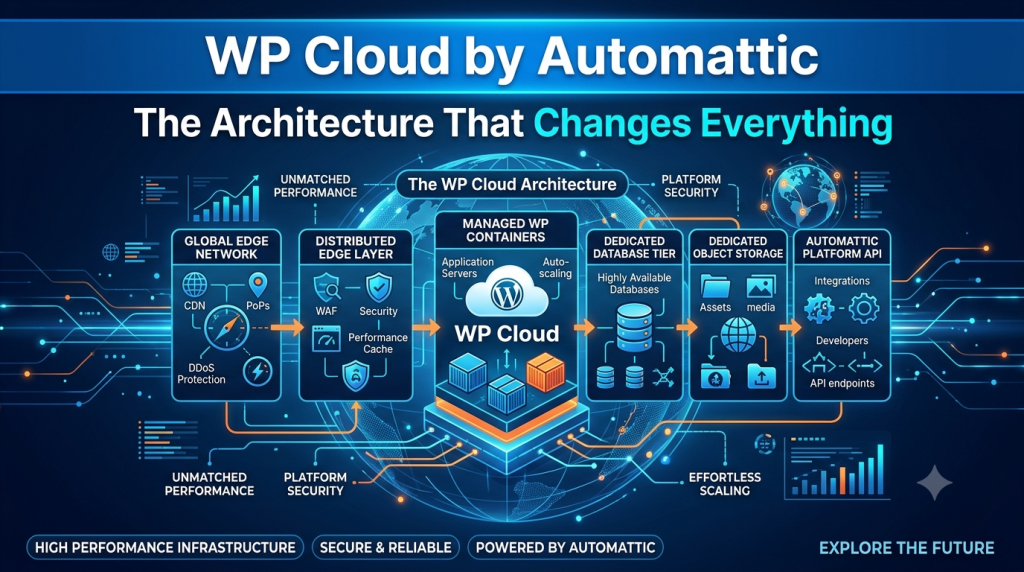
WP Cloud by Automattic:
The Architecture That Changes Everything
An authoritative expert review of the Platform-as-a-Service that powers WordPress.com, Pressable, and a growing ecosystem of hosting partners — and why it is the most structurally significant shift in WordPress hosting since managed hosting was invented.
What Is WP Cloud by Automattic?
In August 2021, Automattic — the company founded by WordPress co-creator Matt Mullenweg and the organisation behind WordPress.com, WooCommerce, Jetpack, Tumblr, and WordPress VIP — made a product available to the wider hosting market that had been quietly powering its own infrastructure since 2019. That product is WP Cloud.
WP Cloud is a Platform-as-a-Service (PaaS) built from the ground up for one purpose: hosting WordPress. It is not a generic cloud infrastructure product that someone adapted for WordPress. It is not cPanel on a virtual machine. It is not a resold slice of AWS or Google Cloud dressed up with a WordPress installer. WP Cloud is a purpose-engineered hosting substrate — built by the same engineers who have run WordPress at internet scale for nearly two decades — and it is now available to third-party hosting companies through a formal partner programme.
WP Cloud is a business-to-business infrastructure product. Individual website owners cannot purchase it directly from Automattic. Instead, you access it by choosing a hosting provider that has been approved as a WP Cloud partner — such as Pressable (fully owned by Automattic), Convesio, Ivapix, or through WordPress.com’s Business and Commerce plans, which run on the same infrastructure.
The distinction matters enormously. What Automattic has done is take the infrastructure that has handled traffic for millions of WordPress sites — including some of the most-visited media properties in the world — and opened it as a platform for the broader hosting ecosystem. The result is a new class of WordPress hosting that sits above traditional managed hosting in terms of WordPress-nativity, but operates at a price point accessible to mid-market providers.
The Architecture — How WP Cloud Differs from Everything Else
To understand why WP Cloud matters, you need to understand what it replaced — and why that replacement is structurally significant. The history of WordPress hosting is a history of layering WordPress on top of infrastructure that was never designed for it.
Traditional Shared Hosting: The Resource Prison
In the classic shared hosting model, a WordPress site occupies a fixed partition on a physical server. It is allocated a defined ceiling of RAM and CPU. When traffic spikes, the site hits its ceiling and degrades or crashes. When a neighbouring site on the same server is attacked or misbehaves, resource contention degrades your site. The server runs a generic LAMP or LEMP stack with no WordPress-specific optimisations beyond a plugin installer. This model has not meaningfully changed in 25 years.
Managed Hosting on Third-Party Cloud: The Leased Abstraction
The next evolution — typified by Kinsta on Google Cloud Platform and WP Engine on a Google Cloud + AWS hybrid — involves purchasing compute capacity from a hyperscaler, adding WordPress-specific management tooling on top, and reselling the combination at a premium. This is a significant improvement over shared hosting: resources are isolated, PHP workers are configurable, server stacks are tuned for WordPress. But the underlying infrastructure is still a general-purpose cloud substrate from a provider with no WordPress heritage.
WP Cloud: The Native Platform
WP Cloud is architecturally different in three fundamental ways.
First Difference: Containerisation at the Site Level
Every site on WP Cloud runs in its own isolated Linux container, defined by Linux namespaces and control groups (cgroups). This is not a virtual machine — VMs carry enormous resource overhead. Containers share the host kernel but isolate processes, file systems, and network interfaces. The result is near-VM-level isolation at a fraction of the cost, with resource allocation that can be adjusted dynamically rather than statically capped at provisioning time.
Second Difference: Burst Scaling of PHP Workers
PHP workers determine how many simultaneous requests a WordPress site can process. On standard managed hosts, PHP workers are fixed per plan: you pay for a tier, you get a number. On WP Cloud, sites can burst to over 100 PHP workers automatically in response to traffic demand. When the spike subsides, workers scale back down. You pay for what you use, not for a static ceiling that is either perpetually over-provisioned or perpetually insufficient.
Third Difference: WordPress-Native by Design
Every layer of the WP Cloud stack — the caching configuration, the PHP execution environment, the database query layer, the security architecture — was designed specifically around WordPress’s operational requirements. This is not a generic platform adapted for WordPress; it is a platform that was built exclusively for WordPress by the organisation that has contributed more to WordPress core than any other commercial entity. That institutional knowledge is embedded in the architecture itself.
Core Elements of WP Cloud Explained
1. Geo-Redundant Automatic Failover
WP Cloud operates across multiple origin data centres. When the primary server encounters any failure — hardware fault, network issue, software crash — the secondary server takes over automatically and in real time. The site does not experience downtime during this transition. This is the infrastructure mechanism behind WP Cloud’s 99.999% uptime commitment — a five-nines figure that corresponds to less than six minutes of potential downtime per year and that most traditional managed hosts do not offer.
2. Four-Layer Caching Architecture
WP Cloud employs a layered caching strategy that covers every bottleneck in the WordPress request lifecycle. The Edge Cache sits closest to the visitor, serving fully rendered pages from the nearest CDN node without touching the origin server at all. Below that, Batcache (leveraging Memcached) handles full-page caching at the server level. WordPress Persistent Object Caching via Memcached eliminates redundant database queries. OPcache compiles and stores precompiled PHP bytecode so the PHP engine does not re-parse code files on every request. Each layer has a specific function; together they reduce origin server load by orders of magnitude.
3. Linux Namespace and cgroup Isolation
The security architecture of WP Cloud is built on the same primitives used by container platforms like Docker and Kubernetes, but implemented at the hosting layer. Linux namespaces restrict each site’s process access to its own allocated resources. Control groups enforce those limits and prevent any single site from consuming more than its allocated share. This eliminates the “noisy neighbour” problem that degrades performance on traditional shared hosting — and it provides a meaningful security boundary between sites on the same physical infrastructure without the cost of full virtualisation.
4. The WP Cloud Partner API
For hosting partners building on WP Cloud, Automattic exposes a full API that allows custom control-panel integrations. Partners can choose a white-label panel solution (PanelAlpha, which offers full WHMCS billing integration), or build a fully custom interface against the WP Cloud API. This means the infrastructure is genuinely abstracted: the hosting partner builds whatever customer experience they want, and WP Cloud handles everything beneath it. The partner sets their own customer pricing on top of Automattic’s wholesale formula.
5. Integrated Security Stack
WP Cloud includes DDoS protection, malware scanning, anti-spam measures, SSL certificates, and TLS traffic encryption as standard features of the platform — not bolt-on additions. The cgroup architecture means that during a DDoS attack against one site, the custom scheduler minimises impact on all other sites sharing the physical infrastructure. Sites on WP Cloud also receive real-time backups as a platform feature, not a premium upgrade.
6. Pressable MCP (Model Context Protocol)
In 2025 and 2026, Pressable — Automattic’s own consumer-facing WP Cloud host — introduced MCP (Model Context Protocol) integration, allowing hosting management through AI interfaces. This positions WP Cloud not just as a hosting platform but as an AI-native infrastructure layer, making site management programmatic in ways that traditional hosting control panels cannot match.
In May 2026, Pressable, WordPress VIP, and a cohort of WP Cloud partners — including Convesio and Ivapix — earned Secure Hosting Alliance (SHA) certification, an initiative by the i2Coalition that independently verifies hosting providers for infrastructure security, anti-abuse practices, privacy, and operational excellence. This is a meaningful third-party validation of WP Cloud’s security architecture.
WP Cloud: Pros & Cons
No infrastructure platform is without trade-offs. Here is an honest assessment of where WP Cloud excels and where it creates challenges.
- Built natively for WordPress by the organisation that maintains it — no abstraction layer mismatch
- 99.999% uptime commitment backed by geo-redundant failover infrastructure
- Burst scaling to 100+ PHP workers eliminates traffic-spike downtime at the platform level
- Four-layer caching covers every bottleneck in the WordPress request stack simultaneously
- Container-level site isolation without VM cost overhead — security and performance in the same mechanism
- Global CDN with 28+ data centres including African PoPs for East and West Africa latency reduction
- Real-time backups, DDoS protection, malware scanning included as platform features — not upsells
- Partner API enables white-label deployments — growing ecosystem of WP Cloud-powered hosts
- SHA-certified security architecture independently verified in 2026
- Jetpack Security bundled on Pressable’s consumer offering (a $19.95/month value)
- Not directly purchasable — requires going through an approved hosting partner, adding a product layer
- Partner ecosystem still maturing — quality and support depth varies significantly between partners
- Wholesale pricing formula is complex (PHP workers × RAM × storage) — opaque to end customers
- No dedicated server option within the WP Cloud model — enterprises requiring bare-metal should look at WordPress VIP instead
- Smaller global data centre footprint than hyperscalers (Google Cloud: 40+ regions; WP Cloud: 4 origin locations plus CDN)
- Not suitable for non-WordPress workloads — purpose-built exclusivity cuts both ways
- Partner onboarding process requires technical resource investment from the hosting company side
- Automattic’s ongoing community tensions (particularly around trademark and contribution disputes) create some ecosystem uncertainty
Who Is WP Cloud Best For?
Because WP Cloud operates as a B2B infrastructure product, “who it is for” has two distinct answers: the hosting partners who build on it, and the end customers who ultimately run sites on it.
WordPress Agencies Managing Multiple Client Sites
Agencies on Pressable or other WP Cloud partners benefit from centralised dashboards, white-label capabilities, staging environments, and platform-level reliability that eliminates client site emergencies caused by hosting failures.
High-Traffic WooCommerce Stores
The burst scaling architecture was purpose-built for WooCommerce’s traffic volatility — seasonal spikes, campaign launches, flash sales. Sites that regularly need 40–100+ simultaneous PHP workers get that capacity automatically, not after a support ticket.
High-Traffic Media and Publishing Sites
Publishers that experience viral traffic events — a story picked up by international outlets, a product launch covered by major tech press — need failover infrastructure that responds in seconds, not minutes. WP Cloud’s geo-redundant origin cluster is built for this pattern.
Hosting Companies Looking to Compete Without Building Infrastructure
The WP Cloud partner programme lets regional hosting companies — including those in emerging markets — offer enterprise-grade WordPress infrastructure without the capital expenditure of building their own data centre relationships, server estate, or WordPress-specific engineering team.
Global Businesses Needing Multi-Region Performance
With 28+ CDN PoPs including nodes in Africa, WP Cloud via Pressable or WordPress.com delivers edge-cached content to global audiences at latencies that local shared hosting cannot approach, regardless of origin server location.
Developers Who Want Platform Power Without DevOps Overhead
WP Cloud partners expose SSH access, WP-CLI, Git integration, and staging environments as standard. Developers get infrastructure-level tools without managing containers, orchestrators, or server configurations themselves.
Personal blogs and small brochure sites on low budgets will find the WP Cloud pricing tier (accessible via Pressable or WordPress.com Business plans) more expensive than shared hosting alternatives. For sites receiving under 5,000 visits per month with no e-commerce, a basic managed shared plan may be disproportionately specified. WP Cloud’s value proposition compounds with traffic volume and business criticality.
WP Cloud Pricing Structure
WP Cloud operates on a usage-based wholesale pricing model for hosting partners, which is then marked up by each partner for their customers. Understanding both layers matters — the wholesale formula determines your infrastructure cost floor; the partner’s mark-up determines what you actually pay.
The Wholesale Formula (Partner-Facing)
Automattic charges hosting partners a formula-based fee per site that accounts for PHP workers, RAM, and storage. The architecture reflects a genuine usage-based billing philosophy — partners pay for what sites actually consume rather than pre-purchasing fixed tier blocks.
( (PHP Workers − 2) × RAM per 512MB unit × $6 )
+ ( Storage ≤200GB − 25GB base ) × $0.25/GB
+ ( Storage >200GB ) × $1.00/GB
+ $200 base platform fee
End-Customer Pricing (Via WP Cloud Partners)
| Provider | Plan | Monthly (USD) | Sites | Key Features |
|---|---|---|---|---|
| WordPress.com | Business | $25/mo (annual) | 1 | Plugin support, WP Cloud infrastructure, 50GB storage |
| WordPress.com | Commerce | $45/mo (annual) | 1 | Full WooCommerce, WP Cloud, premium themes, 50GB |
| Pressable | Personal | $25/mo | 1 | Jetpack Security, global CDN, 24/7 WP support |
| Pressable | Starter | $45/mo | 3 sites | 50K visits/mo, SSH, WP-CLI, Git, staging |
| Pressable | Pro | $85/mo | 10 sites | 150K visits/mo, white-label dashboard option |
| Pressable | Agency | Custom | 30–unlimited | Volume discounts, Automattic for Agencies programme |
| Convesio | Scale | $100+/mo | 1 | WooCommerce-focused, containerised, burst scaling |
Automattic for Agencies: The Volume Pricing Tier
Agencies managing multiple client sites can join the Automattic for Agencies programme, which offers volume discounts of up to 70% across WordPress.com and Pressable hosting, plus Jetpack and WooCommerce extensions. Revenue-share arrangements are also available for agencies that refer clients to Automattic products. The programme is free to join and progression within it is driven by cumulative revenue generated across the Automattic ecosystem.
At equivalent traffic levels (around 50,000 visits/month, 3 sites), WP Cloud via Pressable at ~$45/month is directly price-competitive with Kinsta’s Starter plan at $29.17/month and WP Engine’s Essential at $25/month. The WP Cloud difference is not significant cost savings — it is superior WordPress nativity and architectural depth at a comparable price point.
The Game-Changer: The New Trend WP Cloud Created in WordPress Hosting
Before WP Cloud, the WordPress hosting market had a structural ceiling. At the top end was managed hosting — Kinsta, WP Engine, SiteGround — where specialised WordPress management sat on top of general-purpose cloud infrastructure. Below that was the vast undifferentiated mass of shared hosting. Between these two tiers, there was no middle path for hosting providers who wanted to offer enterprise-quality WordPress infrastructure without the capital and engineering investment required to build it from scratch.
WP Cloud broke that ceiling. It introduced a concept that had no prior precedent in the WordPress market: licensed, white-label, purpose-built WordPress infrastructure available to any qualified hosting partner.
The “Infrastructure-as-a-WordPress-Platform” Model
The trend WP Cloud created is what we can call Infrastructure-as-a-WordPress-Platform (IaWP) — a model in which the underlying hosting substrate is not built by the hosting company but licensed from the organisation that has the deepest institutional knowledge of WordPress at scale. This inverts the traditional hosting value chain.
Previously, a hosting company that wanted to offer premium WordPress performance had two options: build their own infrastructure (enormous capital cost, years of engineering) or resell someone else’s generic cloud at a markup (no real differentiation). WP Cloud introduced a third option: license a purpose-built WordPress PaaS and compete on product experience, pricing, support, and market focus — while the infrastructure quality is guaranteed by Automattic.
Democratising Enterprise WordPress Infrastructure
The downstream effect of this model is significant. A regional hosting company in East Africa, Southeast Asia, or Latin America — markets where building enterprise-grade WordPress infrastructure from scratch is economically prohibitive — can now offer an infrastructure tier that is architecturally equivalent to what powers WordPress.com. That is a structural shift in the competitive geography of WordPress hosting.
The Ecosystem Multiplier
WP Cloud also introduced a trend toward ecosystem-layered hosting — where the infrastructure layer (WP Cloud), the security layer (Jetpack), the e-commerce layer (WooCommerce), and the development tooling layer (Studio, WP-CLI) are all interconnected products from the same organisation. No other hosting infrastructure provider operates with this degree of vertical integration across the WordPress stack. It is the reason Pressable can bundle Jetpack Security (retail value $19.95/month) with every plan — not as a partnership deal, but because both products are owned by the same parent company.
WP Cloud vs. The Big Players: How It Competes
WP Cloud is not simply a hosting product — it is a platform that enables hosting products. When Pressable or a WP Cloud partner competes in the market, they are bringing WP Cloud’s infrastructure to the fight. Here is how that infrastructure stacks up against the dominant players in managed and cloud WordPress hosting.
Kinsta’s strength is its Google Cloud C3D compute and 37 global data centre regions — the broadest origin coverage of any managed host. Its TTFB averages 68ms and the Cloudflare Enterprise CDN (including Nairobi PoP) is included on all plans. Where WP Cloud via Pressable has the edge: deeper WordPress nativity and burst scaling. Where Kinsta leads: more data centre regions and arguably the most polished management dashboard in the category.
WP Engine’s dual-cloud architecture (GCP + AWS) and EverCache technology make it the gold standard for agency workflow tooling, with 40-day backup retention, phone support, and the Local development environment. WP Cloud matches or exceeds on infrastructure nativity but WP Engine maintains advantages in white-label client portal depth and the StudioPress theme library.
SiteGround runs on Google Cloud and has built impressive WordPress-specific tooling (SG Optimizer, Ultrafast PHP). Its entry-level pricing is more aggressive than WP Cloud’s accessible partners. However, SiteGround’s caching and scaling architecture are proprietary add-ons to a general platform; WP Cloud’s equivalent capabilities are structural, not plugin-dependent.
Liquid Web and its managed WordPress brand Nexcess own their own data centre infrastructure — a genuine differentiator for enterprises with specific compliance and sovereignty requirements. WP Cloud cannot match this control model. Where WP Cloud competes: automatic burst scaling, which Liquid Web’s fixed-resource Nexcess plans do not offer by default.
Cloudways occupies a different position — a cloud management layer over multiple IaaS providers, giving customers choice of underlying infrastructure. Cloudways Autonomous (Kubernetes-based) now offers auto-scaling comparable to WP Cloud’s burst model. WP Cloud has the advantage of WordPress nativity; Cloudways has the advantage of infrastructure choice and lower entry-level pricing.
DigitalOcean is not a direct competitor — it is a raw infrastructure provider that developers use to self-host WordPress. The “DevOps tax” of self-managed WordPress on DigitalOcean (server configuration, updates, security patching, scaling logic) is precisely the overhead that WP Cloud eliminates. WP Cloud is what you get when you want DigitalOcean-level control without DigitalOcean-level operational burden.
The Architectural Comparison Matrix
| Architecture Feature | WP Cloud | Kinsta | WP Engine | Cloudways | SiteGround |
|---|---|---|---|---|---|
| WordPress-Native Platform | ✓ Native PaaS | ⚡ Managed on GCP | ⚡ Managed on GCP+AWS | ✗ Generic + WP tools | ⚡ Managed on GCP |
| PHP Worker Burst Scaling | ✓ Auto to 100+ | ⚡ Fixed per plan | ⚡ Fixed per plan | ✓ K8s (Autonomous) | ⚡ Limited burst |
| Container Isolation per Site | ✓ Linux cgroups | ✓ Container-based | ✓ Isolated environment | ✓ K8s pods | ⚡ Account isolation |
| Multi-Layer Caching | ✓ 4 layers native | ✓ Redis + Nginx | ✓ EverCache | ⚡ Varnish + Redis | ✓ SG Optimizer |
| Geo-Redundant Failover | ✓ 4 origin DCs | ⚡ GCP zones | ✓ GCP + AWS multi | ⚡ Per-provider | ⚡ GCP zones |
| Uptime Commitment | ✓ 99.999% | ✓ 99.99% | ✓ 99.99% | ⚡ 99.99% | ⚡ 99.9% |
| Real-Time Backups | ✓ Platform-level | ✓ Daily + on-demand | ✓ 40-day retention | ⚡ Weekly automated | ⚡ Daily |
| White-Label Partner API | ✓ Full API + WHMCS | ⚡ Agency dashboard | ✓ White-label portal | ⚡ Agency accounts | ✗ Limited |
🥇 Kinsta — Our #1 Recommended Managed Host
Google Cloud C3D · 37 data centres · Cloudflare Enterprise CDN · Johannesburg region for East Africa · 99.99% SLA
🥈 WP Engine — Agency & WooCommerce Leader
Google Cloud + AWS · EverCache · Phone support · 40-day backups · Hack Fix Guarantee · Genesis Framework included
The Future of WP Cloud
WP Cloud is not a finished product. It is a platform in active development, and the trajectory of that development is pointing toward several significant expansions.
AI-Native Hosting Management
The introduction of the Pressable MCP (Model Context Protocol) in 2025–2026 is the most structurally interesting near-term development. MCP allows hosting management operations — site creation, staging deployments, configuration changes, performance diagnostics — to be executed through AI interfaces. This moves WordPress hosting from a GUI-and-ticket model into a conversational, programmatic management paradigm. As AI tooling becomes standard in developer workflows, a hosting platform with native MCP support has a meaningful adoption advantage over platforms that require GUI interaction for every management operation.
Expanding the Partner Ecosystem
The WP Cloud partner programme is still early in its market penetration. As of mid-2026, the partner list includes Pressable, Convesio, Ivapix, Infinite Source, and a small number of other approved providers. The infrastructure is ready to support significantly more partners — and Automattic has signalled through the Automattic for Agencies programme that growing this ecosystem is a strategic priority. The addition of more regional partners (including in emerging markets) is likely over the next 18 months.
Deeper Integration Across the Automattic Stack
Automattic’s product portfolio — WordPress.com, WooCommerce, Jetpack, WordPress VIP, Tumblr, and WP Cloud — is increasingly being integrated at the infrastructure level rather than the plugin level. The direction of travel is toward a fully unified WordPress operating environment where hosting, e-commerce, security, and performance tooling are a single coherent platform rather than separately purchased components. WP Cloud is the infrastructure foundation of that unified stack.
Competing at the Enterprise Tier
WordPress VIP — Automattic’s enterprise WordPress product — is the only FedRAMP-authorised WordPress provider, handling government and regulated-industry deployments. As WP Cloud matures and the SHA certification ecosystem expands, the gap between WordPress VIP (enterprise, compliance-grade) and WP Cloud (high-performance, commercial-grade) may narrow, with WP Cloud increasingly capable of handling enterprise workloads that do not require regulatory certifications.
Automattic’s strategic position is unique: it is simultaneously the dominant commercial contributor to WordPress core, the operator of the world’s largest WordPress hosting platform, and now the licensor of the WordPress-native infrastructure that competitors can build on. WP Cloud is not just a hosting product — it is Automattic’s bid to become the infrastructure standard for the entire WordPress ecosystem, much as WordPress itself became the content standard for the web.
Final Verdict
WP Cloud by Automattic is the most structurally significant development in WordPress hosting infrastructure in the last decade. It does not compete with Kinsta and WP Engine on their own terms — it changes the terms of competition by introducing a hosting substrate that is architecturally native to WordPress in a way that general-purpose cloud platforms, however well-managed, cannot replicate.
The 99.999% uptime commitment, burst scaling to 100+ PHP workers, four-layer caching architecture, and container-level site isolation are not marketing differentiators bolted onto a generic infrastructure stack. They are structural properties of a platform built by the same engineers who have run WordPress at internet scale since 2005. That provenance is not incidental — it is the product.
For end customers, the practical access point is Pressable (fully Automattic-owned) or WordPress.com’s Business and Commerce plans. Both deliver the full WP Cloud infrastructure at pricing that is directly comparable to Kinsta and WP Engine — making the choice between them a question of workflow preference and ecosystem fit rather than infrastructure quality.
For hosting companies looking to upgrade their product offering without building infrastructure from scratch, the WP Cloud partner programme represents an opportunity that did not exist three years ago: access to the same infrastructure that has hosted tens of millions of WordPress sites, available on a usage-based wholesale basis with a full partner API and white-label capability.
WP Cloud Is the Infrastructure Benchmark That Everyone Else Is Now Chasing
If managed hosting on third-party cloud was the first generation, WP Cloud is the second generation — the first purpose-built, WordPress-native hosting substrate available at commercial scale. It does not merely compete against Kinsta, WP Engine, SiteGround, Liquid Web, Cloudways, and DigitalOcean. It reframes what the category ceiling looks like.