
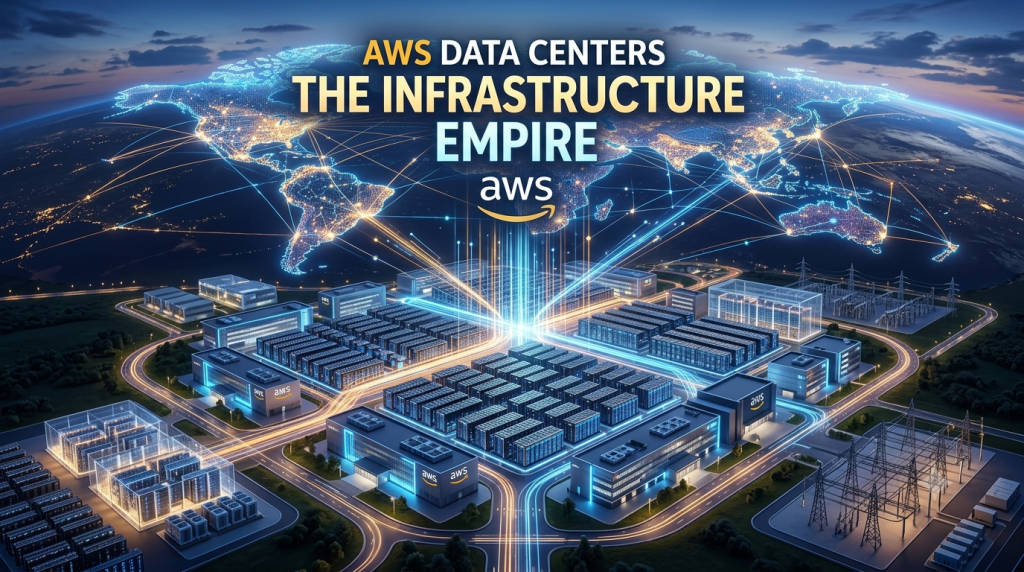
The Infrastructure
Empire
Inside AWS’s 900+ data centers, the trillion-dollar bet that built the internet’s backbone, and why every developer on Earth depends on it.
The Scale of
AWS Dominance
Amazon Web Services isn’t just big. It’s a different category of big — the kind that rewrites what “infrastructure” means for an entire planet.
When developers say “the cloud,” they often mean AWS, even when they’re not fully aware of it. The platform launched in 2006 with a single product — Amazon S3, a simple object store — and in the two decades since, it has grown into a 900-facility, $100-billion-a-year machine that underpins everything from Netflix’s streaming pipeline to NASA’s mission-critical telemetry systems.
As of 2026, AWS commands roughly 31–33% of the global cloud market, a position it has held for years despite intense competition from Microsoft Azure (22–24%) and Google Cloud (11–12%). That margin isn’t just a business statistic — it reflects a structural advantage in infrastructure depth, breadth, and compounding investment that competitors cannot close quickly.
The numbers reveal the depth of this moat. According to documents reviewed by Bloomberg and SourceMaterial, AWS operated approximately 914–924 data center facilities globally as of 2023 — a figure most industry analysts had previously estimated at 100–475. That systematic undercounting wasn’t an accident: AWS deliberately conceals its full footprint for security and competitive reasons. The reality is a network of physical buildings, leased colocation space, and edge nodes spanning more than 50 countries, drawing power equivalent to a mid-sized nation.
The company spent $96.5 billion on data center capital expenditure in 2025 alone. The 2026 budget is projected to exceed $200 billion. To put that in perspective: AWS is spending more on infrastructure in a single year than the GDP of many countries.
For developers, this dominance has a practical consequence: the services, APIs, and primitives AWS provides — compute, storage, database, networking, AI/ML — are not interchangeable commodities. They are deeply integrated, globally distributed, and built at a scale that determines what is even possible to build on the internet today. Understanding AWS’s infrastructure isn’t optional knowledge; it’s prerequisite to understanding modern computing.
You can explore how this infrastructure directly powers WordPress and web hosting at wphostfinder.com/wp-infrastructure — a deep-dive into the cloud layers beneath production web deployments.
How the Infrastructure
Is Architected
AWS’s physical infrastructure maps to a precise logical hierarchy designed for isolation, redundancy, and latency minimization — from the planet down to the server rack.
To understand AWS data centers, developers must first understand how AWS abstracts physical reality into logical constructs. The company does not expose individual data centers to customers. Instead, it presents a tiered model: Regions → Availability Zones → Data Centers → Racks → Servers. Each layer adds redundancy and isolation from the one above it.
Regions
An AWS Region is a discrete geographic area. Each region is completely independent — it has its own power grid connections, networking, and personnel. Regions do not share resources or failure domains. As of mid-2026, AWS operates 38 regions globally, with more announced.
Availability Zones
Each Region contains a minimum of three Availability Zones (AZs). An AZ is one or more discrete physical data center buildings connected via low-latency, high-bandwidth, fully redundant private fiber. The physical separation between AZs within a region is typically tens of kilometers — enough that a natural disaster, power grid failure, or localized outage in one AZ cannot cascade to another, yet close enough that synchronous replication between them is achievable.
This is the key architectural insight that many developers misunderstand: an “AZ” is not a single building. A single Availability Zone may span multiple physical data center facilities within a few kilometers of each other. This is why AWS’s facility count (900+) vastly exceeds the AZ count (120).
Edge Locations & Local Zones
Beyond regions and AZs, AWS deploys infrastructure at the edge. CloudFront CDN operates from 700+ Points of Presence (PoPs) globally — these are not full data centers but rather caching and routing nodes co-located inside third-party carrier facilities and internet exchange points. Local Zones extend compute, storage, and database services into dense metropolitan areas closer to end users, currently numbering over 43 locations.
Inside a Data Center Building
AWS data center buildings are purpose-built to a pattern the company has refined over 20 years. The facilities are deliberately nondescript — typically unmarked, windowless industrial buildings with heavy perimeter security, controlled-access entry, and no public signage. A typical hyperscale facility spans 100,000–500,000 square feet and draws between 20 and 100+ megawatts of power.
Inside, thousands of server racks are organized into pods, with each pod connected by a spine-leaf Clos network fabric. AWS uses custom-designed hardware throughout the stack. The AWS Nitro System — a family of custom ASICs and lightweight hypervisors — offloads virtualization, networking, and storage I/O from the host CPU, giving EC2 instances near-bare-metal performance. AWS Graviton processors (ARM-based CPUs designed in-house) power a growing percentage of EC2 workloads, delivering up to 40% better price/performance than comparable x86 instances.
The scale of Loudoun County, Virginia (AWS’s “US-East-1” home) illustrates the depth of investment: 163 individual data center facilities spread across five Virginia counties, drawing a combined 2,754 megawatts of power — roughly equivalent to what a city of 2 million people consumes. This single metro area is the densest concentration of internet infrastructure ever assembled.
Every AWS Region
& Location
AWS operates 38 public regions with 120 availability zones. Here is the full picture of where AWS infrastructure lives — and what physical locations anchor each region.
North America
South America
Europe
Middle East & Africa
Asia Pacific
China (Partner-Operated)
af-south-1 (Cape Town) or me-south-1 (Bahrain) is increasingly common — both reachable via undersea cables landing at Mombasa. Understanding data center regions is fundamental to choosing the right hosting architecture. Learn more about cloud infrastructure layers →
Why AWS Invests
This Much
At $200 billion budgeted for 2026 alone, AWS’s infrastructure spending isn’t just aggressive — it’s the core mechanism by which the company maintains and widens its lead. Here’s the strategic logic.
1. Compute Is the New Land
In the industrial age, raw materials and land determined who could manufacture at scale. In the digital age, compute capacity and network bandwidth play that role. Amazon understood early — before most competitors — that whoever owned the largest reserve of provisioned infrastructure could offer it on-demand at margins that become self-reinforcing over time. Physical data center capacity cannot be conjured overnight; it requires years of permitting, construction, utility negotiation, and hardware procurement. AWS’s years-long head start translated into a stock of capacity competitors cannot replicate quickly.
2. AI Workloads Are Ferociously Hungry
The explosion of AI model training and inference since 2022 has fundamentally changed infrastructure economics. Training a frontier model like GPT-4 or Anthropic’s Claude requires tens of thousands of GPU/TPU hours. Inference — running that model for millions of simultaneous user queries — demands even more steady-state compute at scale. AWS has responded by deploying Amazon Trainium (custom ML training chips) and Inferentia (custom inference chips), and partnering with Nvidia to install H100 and H200 clusters across its regions. The 500,000 Trainium2 chips in Project Rainier (Indiana) represent a single AI compute cluster that would, by itself, rank among the world’s largest supercomputers.
3. Switching Costs Compound Over Time
The deeper reason AWS invests so heavily is that cloud infrastructure creates massive organizational inertia. A company that builds its data pipeline on Amazon Kinesis, its database on RDS, its compute on EC2, its deployment on ECS, and its ML on SageMaker is deeply embedded in AWS’s API surface. Every integration, every IAM policy, every VPC configuration is an asset that makes migration expensive. AWS investment in new regions and services widens this surface area continuously — each new service is another hook into customer architecture.
4. Regulatory Arbitrage and Sovereign Cloud
Increasingly, data sovereignty regulations (GDPR in Europe, PDPA in Southeast Asia, India’s DPDP Act) require companies to keep data within geographic boundaries. Each new AWS region is simultaneously a capacity expansion and a compliance product — it lets regulated enterprises buy AWS services while satisfying local data residency requirements. The AWS European Sovereign Cloud in Germany, operated entirely by EU-resident staff using EU-located hardware, represents the pinnacle of this strategy: a cloud deployment where even AWS employees outside the EU have no access.
Who Benefits From
AWS Infrastructure
AWS data centers don’t just serve Amazon. Their existence enables entire categories of products, companies, and industries that would otherwise be technically or economically impossible.
How AWS Data Centers
Shape the Internet
AWS is not just infrastructure for its customers. It is infrastructure for infrastructure — a foundational layer that other layers of the internet are built upon.
Internet Routing and the AWS Backbone
AWS operates one of the world’s largest private fiber networks. The AWS Direct Connect backbone spans continents, connecting AWS regions to each other and to enterprise networks with dedicated, private bandwidth that bypasses the public internet. When Netflix streams a movie or when you push code to a GitHub repository (which runs on Azure, connecting via peering to AWS S3), a significant percentage of that data traverses AWS-owned or AWS-connected fiber.
Amazon’s peering arrangements at internet exchange points (IXPs) globally mean that for many major applications, traffic never leaves Amazon-adjacent infrastructure from origin to delivery. AWS is an Autonomous System (AS16509) — it announces its own IP prefixes to the global BGP routing table, meaning the internet’s routing infrastructure literally orbits around AWS’s address space.
DNS: The Internet’s Phone Book Runs on AWS
Amazon Route 53 resolves hundreds of billions of DNS queries daily. When a user types a domain name, there’s a meaningful probability the resolution flows through Route 53’s globally distributed name servers. Route 53’s health-checking, latency-based routing, and geolocation routing make it not just a DNS service but an active traffic management layer that shapes how requests traverse the internet based on where they originate.
Content Delivery: 700+ Edges of the Internet
CloudFront’s 700+ PoPs are embedded inside carrier hotels and internet exchanges globally. When a JavaScript bundle, image, or video is cached at a CloudFront edge, it is served from a physical location that may be kilometers from the end user — not from an origin server thousands of miles away. This collapses the effective internet for a large fraction of its traffic. An end user in Nairobi accessing a CloudFront-cached asset may receive it from a PoP in Nairobi itself, traversing a total of milliseconds from ISP to content.
The AWS Outage Ripple Effect
The degree to which AWS shapes the internet became viscerally clear during the December 2021 AWS us-east-1 outage. When a misconfiguration at the Virginia region caused service degradations, it did not only affect AWS customers: it disrupted Ring doorbells, Disney+, Netflix, Roku, Slack, Epic Games, McDonald’s mobile ordering, and Amazon’s own warehouse operations. A significant portion of the internet’s application layer became unresponsive — not because those services were poorly architected, but because they (and their dependencies) shared a common infrastructure substrate.
The Shared Responsibility Model: What AWS Owns vs. What You Own
AWS’s Shared Responsibility Model defines the boundary between what the platform guarantees and what its customers must manage. AWS guarantees the security and availability of the physical facilities, hypervisor layer, managed service infrastructure, and global network fabric. Customers own: data encryption, access control, application security, OS patching on EC2 instances, and architecture decisions around multi-AZ deployment. This model is the operating contract between AWS and the developers building on top of it — understanding it is prerequisite to building anything production-grade on AWS.
Core Services Powered by
These Data Centers
The 200+ AWS services are the interface layer between the physical infrastructure and the applications developers build. Here’s how the key service categories map to data center capabilities.
Amazon EC2 is the foundational compute primitive — virtualized CPU and memory backed by the Nitro hypervisor on bare-metal hardware in AWS data centers. With instance families covering general purpose (M8, T4g), compute-optimized (C7g, Hpc7g), memory-optimized (R8g, X2idn), storage-optimized (I4i), and GPU/AI (P5, Trn2), EC2 covers every conceivable workload type. AWS Lambda extends this into serverless — functions execute in milliseconds in isolated micro-VMs (Firecracker), billed by the millisecond, with no server management whatsoever.
Amazon S3 is probably the single most impactful cloud service ever created. Object storage at planetary scale — currently storing exabytes of data across all 38 regions, with 11 nines of durability (99.999999999%). S3’s architecture distributes each object across multiple physical facilities within an AZ and replicates across AZs by default with Standard storage class. EBS provides block storage for EC2 instances (analogous to hard drives), while EFS and FSx provide managed file systems. The physical medium has evolved: AWS’s modern storage infrastructure uses NVMe SSDs, with tiering to S3 Glacier for cold data archival at $0.004/GB/month.
AWS operates the broadest managed database portfolio in the industry. Amazon Aurora is a MySQL/PostgreSQL-compatible database engine rebuilt from scratch for the cloud — it separates compute from storage, with storage scaling independently up to 128TB and automatically replicating across 3 AZs (6 copies of data). For NoSQL, DynamoDB delivers single-digit millisecond latency at any scale, serving millions of requests per second for applications like Amazon’s own shopping cart. ElastiCache (Redis/Memcached), Neptune (graph), Timestream (time-series), QLDB (ledger), and Keyspaces (Cassandra) complete a database portfolio that spans every modern data model.
AWS’s Virtual Private Cloud (VPC) is a software-defined network that runs on top of AWS’s physical fabric. Developers define their own IP address ranges, subnets, route tables, and firewalls — all enforced by the Nitro hardware at the hypervisor level without any performance penalty. Transit Gateway connects thousands of VPCs and on-premises networks into hub-and-spoke topologies. Direct Connect provides dedicated 1–100Gbps physical links between enterprise data centers and AWS over private fiber, bypassing the internet entirely.
Amazon SageMaker is the managed ML platform built on top of EC2 GPU/Trainium instances — covering data labeling, model training, hyperparameter tuning, model hosting, and inference pipelines. Amazon Bedrock delivers foundation model APIs from Anthropic (Claude), Meta (Llama), Cohere, Stability AI, and Amazon’s own Nova models as serverless endpoints. This entire layer runs on the physical Trainium and Inferentia silicon in AWS data centers — chips designed specifically for ML at a TCO advantage over GPU clusters.
The Road Ahead:
2026 and Beyond
AWS is not maintaining infrastructure. It is in the midst of the most aggressive private infrastructure build-out in history — and the next wave will reshape what cloud computing means.
Doubling Capacity by 2027
AWS added 3.8 gigawatts of new power capacity in the 12 months to October 2025 — the largest single-year expansion in cloud history. The company is on track to double its total capacity again by 2027, driven primarily by AI workload demand that is growing faster than any prior cloud workload category. The construction pipeline includes: the $20B Pennsylvania AI campus (1,200 acres adjacent to a nuclear power plant), $15B Northern Indiana campus (2.4 GW, Project Rainier expanded), $13B Mississippi complex, and $50B in US government-region capacity.
Nuclear Power Deals
Power availability — not hardware — is the primary constraint on AWS expansion. The company has responded by signing agreements with nuclear operators to access carbon-free, always-on baseload power. Amazon’s acquisition of Talen Energy’s nuclear-adjacent Pennsylvania campus and agreements with Dominion Energy’s nuclear fleet represent a strategic move to secure power that no amount of money can quickly replicate: permitted nuclear generation capacity takes a decade to build. AWS’s nuclear strategy is as much a competitive moat as the data center buildings themselves.
AWS Outposts: The Data Center in Your Rack
AWS Outposts ships the same Nitro hardware, software-defined networking, and managed services used in AWS regions directly into enterprise on-premises environments. A rack of Outposts hardware in a bank’s private data center runs the same APIs as us-east-1 — allowing regulated workloads to stay physically on-premise while consuming AWS tooling, operational models, and managed services. This collapses the distinction between “cloud” and “on-premises” for enterprises that cannot or will not migrate everything to public cloud.
The AI Inference Buildout
While most developer conversation focuses on training large models, the infrastructure investment required for inference at scale is equally massive and growing faster. Every time a user makes a ChatGPT query, a GitHub Copilot autocomplete, or a Claude conversation turn, dozens to hundreds of GPU/Inferentia inference instances execute the forward pass. As AI penetrates every application layer, inference compute becomes a steady-state, 24/7 infrastructure load — not a bursty batch job. AWS is building inference-optimized infrastructure at a pace that reflects the expectation that AI inference will be the dominant cloud workload category within three years.
For developers building on WordPress infrastructure, these shifts matter concretely: managed hosts will increasingly run on Graviton-powered fleets, AI-assisted features (content generation, tag suggestion, search) will be powered by Bedrock APIs, and global deployments will leverage a growing roster of AWS regions to eliminate latency for site visitors in previously underserved markets.
Explore how cloud infrastructure choices propagate into WordPress hosting performance and architecture at wphostfinder.com/wp-infrastructure, and track the latest AWS service announcements directly at aws.amazon.com/new.
Go deeper into cloud infrastructure
Understand how AWS’s physical infrastructure translates into WordPress hosting performance, managed database choices, and CDN configuration.