
Who Really Runs WordPress Hosting? An Infrastructure-Level Review of the Top Hosts
Published on WP Host Finder — see also our full directory of top WordPress hosting providers and our WP Infrastructure guide.
A note on scope: this review maps the major, independently verifiable WordPress hosts to their underlying infrastructure. Our directory’s Top 100 list renders its rankings dynamically, so this piece covers the hosts that consistently appear across independent benchmark sources rather than reproducing that table row-for-row. If you share the exported list, we’ll extend this mapping to all 100 entries by name.
Most “best WordPress hosting” lists compare price tags and uptime badges. Almost none of them answer the more important question: whose servers is your site actually sitting on? Strip away the branding, and the WordPress hosting market collapses into three real infrastructure tiers — a handful of hyperscale clouds, a layer of resellers who repackage that cloud capacity, and a shrinking group of hosts still running their own bare-metal data centers. Below is a sourced breakdown of where the top names in the industry actually sit, how reseller hosting plugs into each layer, and a critical read on what that means for buyers.
The three infrastructure tiers
Tier 1 — Hyperscale cloud (Google Cloud / AWS / Azure). Premium managed WordPress hosts that build directly on a hyperscaler’s compute, storage, and networking layer, then wrap it in WordPress-specific tooling (containers, staging, caching, dashboards).
Tier 2 — Multi-cloud resellers. Platforms that don’t own infrastructure at all. They sit on top of AWS, Google Cloud, DigitalOcean, Vultr, or Linode and sell a managed layer (server provisioning, caching stack, security) on a markup. This is where “reseller hosting” in the WordPress space concentrates most heavily.
Tier 3 — Self-owned bare metal / colocation. Legacy and budget hosts that still own or lease their own physical racks, mostly serving shared and entry-level hosting at scale.
Tier 1: who’s actually on Google Cloud and AWS
Kinsta — 100% Google Cloud Platform
Kinsta is the cleanest case in the entire market: it runs on Google Cloud after migrating its infrastructure there from second-tier cloud providers that suffered from inconsistent uptime and lack of live migration. The company uses Compute Engine’s large machines, with up to 96 CPUs and hundreds of gigabytes of RAM, and runs every site in its own isolated container. More recently it has moved to Google Cloud’s C3D compute-optimized machines built on AMD EPYC Genoa processors with DDR5 memory and PCIe 5.0 NVMe storage, layering Cloudflare’s network of 310+ points of presence on top as its edge caching layer. Kinsta currently spans 27 global data center regions on Google Cloud, with some sources citing as many as 30+ as new regions roll out.
👉 Try Kinsta — get 30 days free hosting
WP Engine — GCP by default, AWS and Azure on premium tiers
WP Engine is the multi-cloud premium host. By default, shared and most Premium plans provision on Google Cloud, with AWS available as clustered servers and Microsoft Azure servers both reserved for Premium plans. Historically WP Engine expanded this footprint by building strategic relationships with both Google Cloud Platform and AWS to add data center regions in London, Sydney, and Frankfurt, extending coverage so customers can run sites and store data within the U.S., Canada, U.K., Australia, Germany, Ireland, Belgium, Taiwan, and Japan. WP Engine’s newer Headless Platform product is GCP-only at launch, per its own support documentation.
SiteGround — fully migrated to Google Cloud
SiteGround ran 15 years on its own bare metal before making a deliberate switch. In its own words: SiteGround started using Google Cloud Platform to host part of its infrastructure after its first locations went live in Iowa, Eemshaven, London, and Singapore, having run on bare metal for 15 years prior. The platform has since scaled that footprint to 11 full data centers across four continents, all on Google Cloud Platform — four in the US (Ashburn, Council Bluffs, Dallas, Los Angeles) and five across Europe (London, Madrid, Eemshaven, Frankfurt, Paris), with data centers paired for geographic redundancy, such as Iowa backing up to Virginia and Sydney to Singapore.
Pressable, Pagely, and the rest of the GCP/AWS-native bucket
Outside the consumer-facing giants, several enterprise managed-WordPress specialists build directly on AWS rather than reselling it:
- Pressable — owned by Automattic, built on WP Cloud infrastructure, AWS-native.
- Pagely — now part of GoDaddy Pro, AWS-native enterprise WordPress hosting.
- Rocket.net — runs on Google Cloud’s premium network tier paired with Cloudflare Enterprise edge caching.
- WPX Hosting — operates its own high-performance infrastructure with a proprietary CDN, blending owned hardware with cloud capacity.
Quick-reference: major hosts by infrastructure tier
| Host | Infrastructure | Tier |
|---|---|---|
| Kinsta | Google Cloud Platform (exclusive) | 1 — Hyperscale |
| WP Engine | Google Cloud (default) + AWS + Azure (Premium) | 1 — Hyperscale |
| SiteGround | Google Cloud Platform (exclusive) | 1 — Hyperscale |
| Pressable | AWS (via Automattic’s WP Cloud) | 1 — Hyperscale |
| Pagely | AWS | 1 — Hyperscale |
| Rocket.net | Google Cloud (premium tier) + Cloudflare Enterprise | 1 — Hyperscale |
| Cloudways | Reseller of AWS, Google Cloud, DigitalOcean, Vultr, Linode | 2 — Reseller |
| RunCloud | Panel over self-provisioned DigitalOcean/Vultr/Linode/AWS | 2 — Reseller |
| GridPane | Panel over self-provisioned DigitalOcean/Vultr/Linode/AWS | 2 — Reseller |
| xCloud | Panel over self-provisioned Hetzner/DigitalOcean/Vultr | 2 — Reseller |
| Bluehost | Owned data centers (Newfold Digital) | 3 — Bare metal |
| HostGator | Owned data centers (Newfold Digital) | 3 — Bare metal |
| Hostinger | Owned data centers, 10+ global locations | 3 — Bare metal |
| GoDaddy | Owned data centers + colocation | 3 — Bare metal |
| DreamHost | Owned data centers | 3 — Bare metal |
| A2 Hosting / Hosting.com | Owned data centers with Turbo/LiteSpeed servers | 3 — Bare metal |
| InMotion Hosting | Owned data centers | 3 — Bare metal |
| Liquid Web / Nexcess | Owned data centers + cloud hybrid | 3 — Bare metal |
| IONOS | Owned European data centers | 3 — Bare metal |
| GreenGeeks | Owned data centers, renewable-energy offset model | 3 — Bare metal |
| ScalaHosting | Owned data centers + self-managed cloud VPS | 3 — Bare metal |
| HostArmada | Owned data centers | 3 — Bare metal |
| NameHero | Owned data centers, LiteSpeed-based | 3 — Bare metal |
Table compiled from each provider’s own infrastructure disclosures and the sourced reviews cited throughout this article. Where a host blends models (e.g. Liquid Web/Nexcess), it’s listed under its primary, historically dominant infrastructure.
Tier 2: reseller hosting — the layer that doesn’t own anything
This is the part of the market most “top 100” lists blur together with Tier 1, but the distinction matters: a reseller doesn’t own racks or sign infrastructure deals at Kinsta’s or WP Engine’s scale — it buys VPS capacity at wholesale and resells it with a managed layer on top.
Cloudways — the dominant WordPress reseller
Cloudways is the largest example of pure-play infrastructure reselling in the WordPress space. It gives users access to five leading cloud server providers — AWS, Google Cloud Platform, DigitalOcean, Linode, and Vultr through one dashboard, rather than owning any infrastructure itself. The underlying server room and servers come from those partner cloud vendors, while Cloudways supplies its own hosting platform and management layer on top, putting multiple clouds into one console. Since DigitalOcean’s 2022 acquisition of Cloudways, the upside has been DigitalOcean’s technical backing and expanded provider options, while support quality has reportedly become less personal post-acquisition. Pricing reflects the markup directly: Cloudways starts at $14/month for DigitalOcean, $16/month for Vultr High Frequency, and roughly $37–38/month once you select AWS or Google Cloud as the underlying provider, with coverage across 65+ data center locations inherited from its five partner clouds.
RunCloud, GridPane, ServerPilot, xCloud
A second wave of smaller reseller-style platforms (RunCloud, GridPane, xCloud) follow the same model on an even thinner margin: they license a control panel that sits on top of infrastructure you provision yourself — usually DigitalOcean, Vultr, or Hetzner — and charge a flat monthly fee instead of a markup baked into hosting cost. One review in our research set framed it bluntly: pay Hetzner, Vultr, or DigitalOcean directly, then a flat monthly fee for a panel like xCloud, with no markup on the infrastructure itself.
Where reseller hosting attaches to each infrastructure tier
Reseller hosting isn’t its own infrastructure category — it’s a commercial layer bolted onto Tier 1 and Tier 3 capacity:
- Attached to hyperscale cloud: Cloudways reselling AWS/GCP/Azure capacity at a managed-hosting markup.
- Attached to independent cloud (DigitalOcean/Vultr/Linode): Cloudways, RunCloud, GridPane, xCloud — the bulk of the WordPress VPS-reseller market sits here because DO/Vultr/Linode pricing leaves more margin for a markup than AWS or GCP does.
- Attached to bare-metal Tier 3 hosts: classic white-label/reseller hosting plans (cPanel-based reseller accounts) sold by Bluehost, HostGator, and most shared-hosting brands, where an agency buys bulk shared-hosting capacity and resells individual accounts to clients. This is the oldest form of “reseller hosting” and is structurally distinct from cloud-reselling platforms like Cloudways.
Tier 3: who still owns the metal
Bluehost / HostGator (Newfold Digital)
Bluehost and HostGator are both part of Newfold Digital, a long-standing owner of physical hosting infrastructure built through the original EIG/Endurance International Group consolidation. They remain firmly in the bare-metal/owned-data-center camp rather than reselling a named hyperscaler, which is also why comparison reviews consistently note their thinner data center footprint — one review found Bluehost limited to around six server locations compared to Cloudways’ 44+ across its five cloud partners.
Hostinger
Hostinger operates its own data centers rather than reselling a hyperscaler, with 10 global data centers across North America, Europe, Asia, and South America giving it the strongest international shared-hosting coverage at its price point, including recent expansion into Brazil, India, and Lithuania to reduce latency for underserved regions.
GoDaddy
GoDaddy similarly runs its own data center footprint alongside colocation deals, positioning it — like Bluehost and Hostinger — as a Tier 3 operator competing on price and bundled services (domains, email) rather than on hyperscale cloud branding.
Pictorial hierarchy of the industry
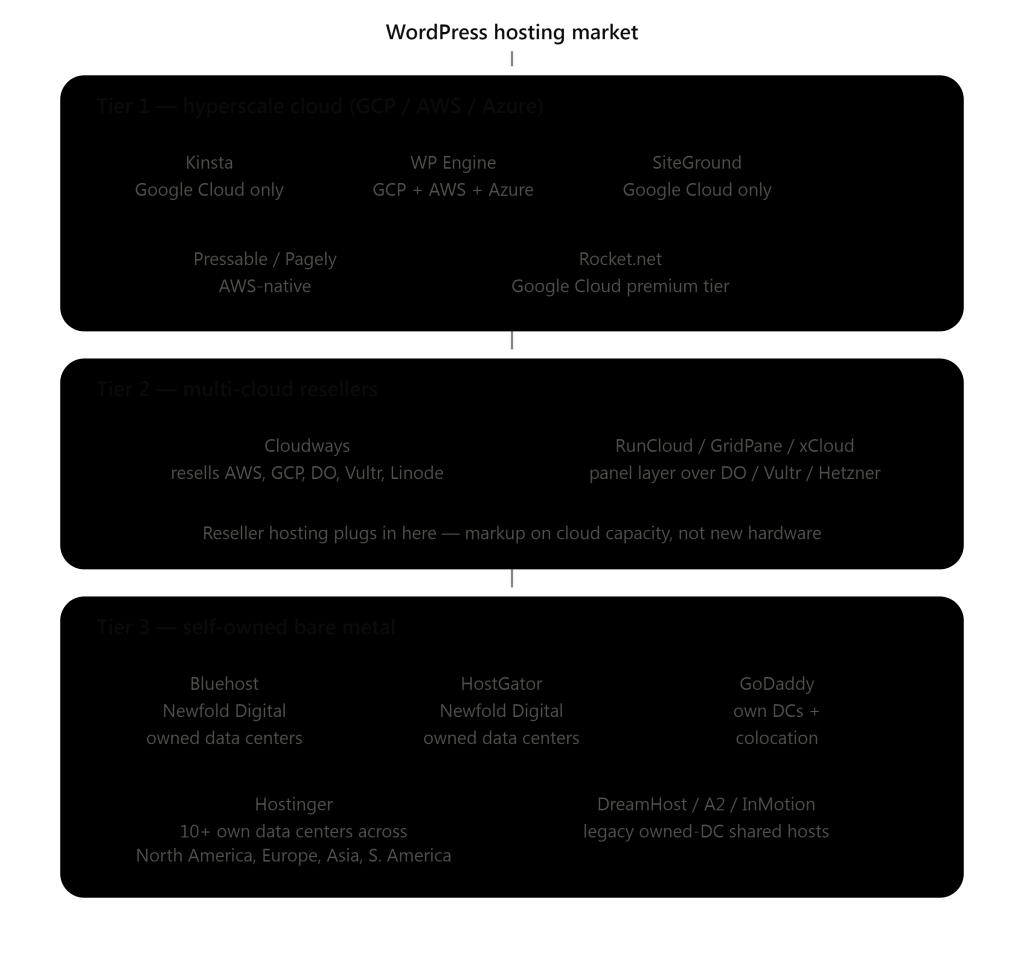
The diagram above maps this structure directly: hyperscale cloud at the top (Kinsta on GCP exclusively; WP Engine and SiteGround on GCP with AWS/Azure options), the reseller layer in the middle (Cloudways spanning five clouds at once; panel-only resellers like RunCloud and xCloud), and bare-metal operators at the base (Bluehost/HostGator, Hostinger, GoDaddy).
What that hierarchy reveals: almost the entire premium end of WordPress hosting now runs on someone else’s cloud. Google and Amazon are the real infrastructure layer beneath Kinsta, WP Engine, SiteGround, and the entire Cloudways resale ecosystem. The “host” you pick is increasingly a managed software and support layer wrapped around the same handful of underlying networks — which is also why outages at GCP or AWS tend to take down multiple “competing” hosts simultaneously.
Critical analysis
The consolidation risk is real. When Kinsta, WP Engine’s default tier, SiteGround, and most of the Cloudways fleet all sit on Google Cloud or AWS, a regional GCP outage isn’t a Kinsta problem — it’s a market-wide event. Buyers comparing these hosts on “reliability” are often comparing the same underlying network with different amounts of redundancy and engineering wrapped around it.
Reseller markup is the price of convenience, not infrastructure. Cloudways’ ~130%+ markup over raw DigitalOcean pricing buys a managed stack, not better hardware — a $12/month DigitalOcean droplet becomes a $24/month Cloudways server for the same underlying box, with the difference paying for a pre-configured Nginx/Apache/Varnish/PHP-FPM stack, automated backups, and monitoring. That’s a legitimate trade for anyone who doesn’t want to run sysadmin themselves, but it’s worth knowing the floor price you’re marking up from.
Bare-metal hosts compete on price and bundling, not raw performance. Tier 3 operators like Bluehost and HostGator persist because of brand recognition, WordPress.org’s historical recommendation, and aggressive entry pricing — not because owned bare metal outperforms hyperscale cloud. Independent testing consistently ranks SiteGround and Hostinger ahead of Bluehost on raw speed despite Bluehost’s name recognition.
“Premium” increasingly means “exclusively hyperscale, with no resale markup absorbed by the customer.” Kinsta’s all-in GCP commitment and WP Engine’s GCP/AWS/Azure blend let them negotiate enterprise cloud contracts directly rather than paying someone else’s markup — which is part of why their pricing sits well above Cloudways-style resale options for comparable raw compute.
Related reading on WP Host Finder
- Top 100 WordPress hosting providers — full directory
- WP Infrastructure guide
- WP Server guide
- Database server guide
- Caching guide
- Security infrastructure guide
External sources cited: Kinsta on Google Cloud — case study · WP Engine server/data center support docs · WP Engine Google Cloud case study · SiteGround’s move to Google Cloud · Cloudways infrastructure provider help center